
While the National Hockey League (NHL) represents the absolute pinnacle of club hockey, international competition offers a unique brand of pride, passion, and global rivalry. For players and fans alike, representing one’s country on the world stage is the ultimate honor.
The two premier international tournaments in men’s and women’s hockey are the Winter Olympic Games and the IIHF (International Ice Hockey Federation) Ice Hockey World Championship. While both showcase elite global talent, they differ drastically in their scheduling, tournament format, roster availability, and global prestige.
Here is a complete breakdown of how the Olympics and the IIHF World Championships compare.
1. Head-to-Head Overview
| Feature | Winter Olympic Games | IIHF World Championship |
| Frequency | Every 4 years | Annual (Every spring) |
| Organizing Body | IOC (in partnership with IIHF) | IIHF |
| Timing in Season | February (Mid-season) | May (Late spring / During NHL Playoffs) |
| Roster Availability | Best-on-best (when NHL participates) | Dependent on eliminated NHL teams |
| Teams Participating | 12 Men’s / 10 Women’s teams | 16 Men’s Top Division teams |
| Global Prestige | Pinnacle of international hockey | High prestige (especially in Europe) |
2. Roster Availability and “Best-on-Best” Status
The fundamental difference between the two tournaments comes down to which players are available to represent their countries.
The Winter Olympics: The Best-on-Best Ideal
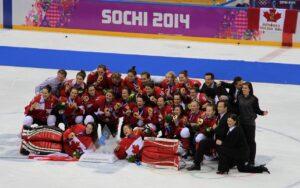
The Winter Olympics take place in mid-February. When the NHL agrees to pause its regular season (as occurred in 1998, 2002, 2006, 2010, and 2014, and returning for 2026), every top player in the world—from North America and Europe—is available.
This creates true “best-on-best” hockey, where dream-team rosters feature legendary superstars competing under intense national spotlight (such as Sidney Crosby’s iconic “Golden Goal” for Canada in 2010).
The IIHF World Championship: The Spring Overlay
The IIHF World Championship is held annually in May. Because this directly overlaps with the Stanley Cup Playoffs, players whose NHL teams are still competing in the postseason cannot participate.
Instead, national rosters are built from a mix of:
-
NHL players whose teams were eliminated from playoff contention or knocked out in Early Rounds.
-
Top European professional stars playing in leagues like the KHL, SHL, or NL.
-
Promising top college and junior prospects.
While this means the World Championship isn’t always a complete “best-on-best” event, it offers phenomenal depth, giving rising young stars and European league standouts their moment to shine.
3. Tournament Formats Explained
OLYMPIC FORMAT:      Group Stage (Preliminary)  ──> Qualification Playoffs  ──> Single-Elimination Knockout (Quarterfinals to Gold)
WORLD CHAMPIONSHIP:  Two 8-Team Groups (Round-Robin) ──> Top 4 Per Group Advance ──> Single-Elimination Knockout (Quarterfinals to Gold)
The Olympic Tournament Format (Men’s)
-
Group Stage: 12 nations are split into three groups of four. Teams play a single round-robin within their group to establish seeding.
-
Qualification Round: The top four seeds (group winners plus the best second-place team) automatically advance to the Quarterfinals. The remaining eight teams compete in a single-elimination play-in round.
-
Knockout Stage: Single-elimination Quarterfinals, Semifinals, and the Bronze/Gold Medal games.
The IIHF World Championship Format (Men’s Top Division)
-
Group Stage: 16 teams are split into two massive groups of eight (Group A and Group B). Every team plays seven round-robin games within their group.
-
Relegation Threat: The bottom team in each group is relegated to Division I Group A for the following year, adding intense high-stakes drama at the bottom of the standings.
-
Knockout Stage: The top four teams from each group advance to an 8-team single-elimination playoff tree culminating in the Gold Medal game.
4. The “Triple Gold Club”
In international hockey, the ultimate personal career achievement is induction into the Triple Gold Club. To qualify, a player or coach must win all three of hockey’s most difficult trophies:
-
A Stanley Cup championship (NHL)
-
An Olympic Gold Medal
-
An IIHF World Championship Gold Medal
Only an elite group of players—including legends like Peter Forsberg, Jaromír Jágr, Jonathan Toews, and Patrice Bergeron—have ever accomplished this monumental feat.
Summary
-
The Winter Olympics represents the rare, high-stakes pinnacle of international sport—a global spectacle where the absolute best players on Earth go head-to-head every four years.
-
The IIHF World Championship is hockey’s trusted annual celebration—a deep, tactical, highly competitive tournament that tests international roster depth and provides nonstop drama every spring.