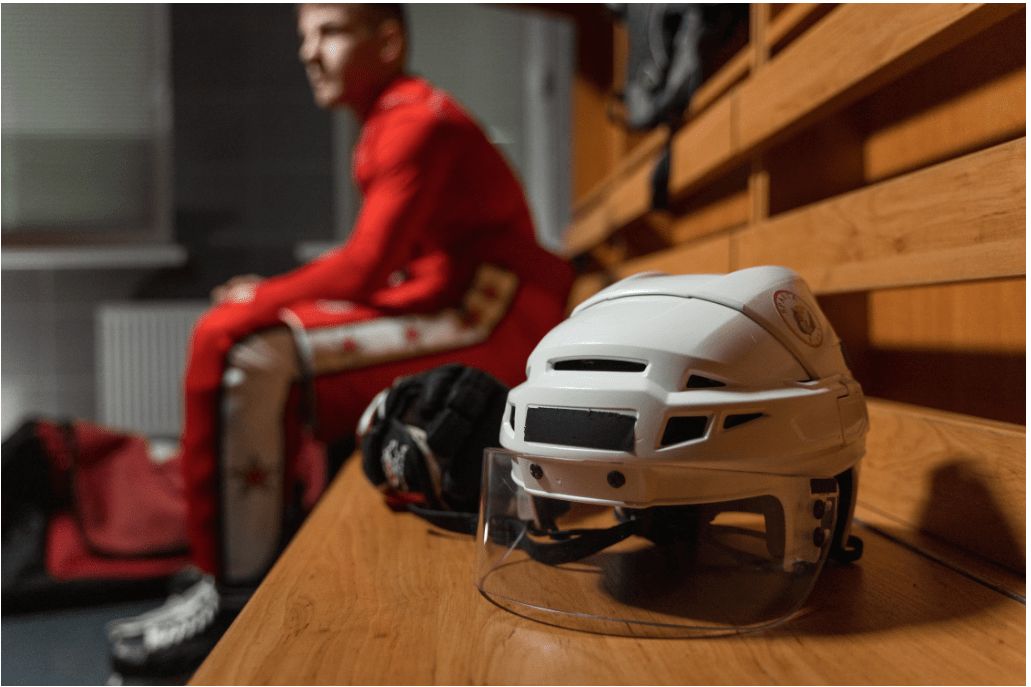
When it comes to hockey equipment, no purchase is more critical than your helmet. A high-end stick might improve your shot velocity, but a high-performing helmet protects your most valuable asset: your brain.
With the rapid evolution of protective technology, understanding how helmets absorb high-velocity impacts, disperse rotational forces, and provide custom comfort is essential for every player and parent.
Here is a comprehensive breakdown of helmet safety standards, advanced protective technologies, top-performing models, and how to choose the right fit.
The Reality of Helmet Concussion Protection
It is important to clarify a fundamental truth: no hockey helmet is 100% concussion-proof. Concussions occur when the brain sloshes or rotates inside the skull due to rapid acceleration or deceleration.
However, modern helmets are specifically engineered to mitigate concussion risk by absorbing linear force (direct impacts) and dampening rotational force (glancing blows that cause the head to twist).
HECC/CSA Certification vs. Virginia Tech STAR Ratings
-
HECC / CSA / CE Certifications: These mandatory league certifications confirm that a helmet meets baseline safety standards to prevent catastrophic injuries (like skull fractures). However, certification is a simple pass/fail test; it does not rank how well one helmet performs relative to another.
-
Virginia Tech STAR Ratings: Virginia Tech’s independent Helmet Lab subjects helmets to 48 laboratory impact tests (measuring linear and rotational accelerations) to assign an objective 1 to 5-star rating. Helmets with lower STAR scores and higher star ratings provide superior statistical concussion risk reduction.
1. Advanced Protective Technologies Explained
Modern top-tier helmets have moved far beyond basic Vinyl Nitrile (VN) foam padding. Leading manufacturers use several proprietary inner liner technologies:
3D-Printed Lattice Structures (e.g., Bauer Nest Tech, CCM Super Tacks X)
-
How It Works: Uses additive 3D-printing to create a web-like elastomeric lattice structure.
-
Benefits: Dynamically deforms under impact to absorb multi-directional forces, provides unmatched breathability, and molds precisely to unique head shapes.
Multi-Density EPP & IMPAX Foam
-
How It Works: Expanded Polypropylene (EPP) is a lightweight, hard plastic foam designed to handle high-energy impacts. Soft comfort foams (like Poron XRD or D3O) sit against the head to absorb low-energy bumps.
-
Benefits: Offers a balance of lightweight protection and high-impact structural resilience.
Smart Fluid & Rate-Sensitive Foams (e.g., D3O® Tech)
-
How It Works: Soft and pliable under normal conditions, but instantly locks up and hardens upon impact to dissipate force before returning to a flexible state.
2. Top Recommended Hockey Helmets for Safety & Comfort
Based on Virginia Tech safety evaluations, independent impact testing, and player fit reviews, here are the top-performing helmets across key categories:
1. Bauer RE-AKT 3D / Super Tacks X (Best Elite Performance & Comfort)
-
Key Features: Features 3D-printed lattice liners, tool-free custom micro-adjustment systems, and multi-density impact pods.
-
Who It’s For: Elite players, competitive adult rec players, or anyone seeking top-of-the-line ventilation, adaptive comfort, and rotational force protection.
2. Warrior Covert CF80 / Covert RS Pro (Best Value Safety)
-
Key Features: Consistently earns 5-Star independent ratings at affordable price points. Employs IMPAX foam zones over high-risk areas like temples and crown.
-
Who It’s For: Players looking for high-ranking concussion protection without spending elite-level prices.
3. Bauer IMS 5.0 / CCM Tacks 710 (Top Budget / Entry-Level Choices)
-
Key Features: Dual-density traditional foam liners with easy side-latch adjustments.
-
Who It’s For: New players, recreational skating, or youth players entering organized hockey on a tight budget.
3. How to Fit a Hockey Helmet Properly
A $500 helmet that fits poorly is far less effective than a $100 helmet that fits correctly. If a helmet is too loose, it will shift during impact, leaving key areas exposed.
Proper Fit Check:
1. Resting position: 1 finger-width above the eyebrows.
2. Shake Test: Head moves, helmet stays locked (no sliding).
3. Pressure Check: Snug wrap without painful temporal pinching.
When Should You Replace a Hockey Helmet?

-
After 5 Years: HECC certifications expire 5 years from the date of manufacture due to degradation of plastics, foam adhesives, and hardware from sweat and UV exposure.
-
After a Major Direct Impact: If you suffer a severe hit or slam your head against the ice or boards, replace the helmet immediately—even if there are no visible external cracks in the outer shell.
-
Never Buy Used Helmets: Used helmets carry hidden internal structural damage, degraded foam, and expired safety certifications.