
In the world of professional sports, no trophy carries the mystique, history, and raw emotional weight of the Stanley Cup. It is the oldest professional sports trophy in North America, but what truly sets it apart is its unique tradition: unlike other major sports leagues that craft a new trophy each year, the exact same physical Stanley Cup is passed from champion to champion.
Every player who wins the cup gets their name permanently engraved onto its silver rings alongside the legends of the game. From its modest origins as a small silver bowl to its status as sports’ most revered icon, here is the fascinating story and bizarre lore behind the Stanley Cup.
1. Origins: A $50 Donation from Royalty
The history of the Stanley Cup begins in 1892 with Sir Frederick Arthur Stanley, the Lord Stanley of Preston and Governor General of Canada. Lord Stanley and his family became avid fans of the newly emerging sport of ice hockey after attending games at the Montreal Winter Carnival.
Recognizing that the sport lacked a supreme championship award, Lord Stanley purchased a small, silver-plated rose bowl in Sheffield, England, for 10 guineas (equivalent to roughly $50 at the time).
He designated it as a “Dominion Challenge Cup” to be awarded annually to the top amateur hockey club in Canada.
-
First Awarded: In 1893 to the Montreal Amateur Athletic Association (MAAA).
-
The Transition to Professionalism: By 1906, professional teams were allowed to challenge for the Cup. By 1926, the National Hockey League (NHL) assumed full operational control of the trophy.
2. Evolution of the Trophy: Growing Ring by Ring
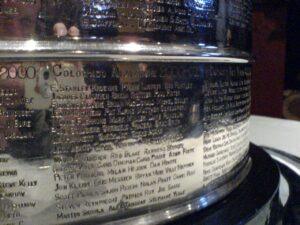
The original silver bowl purchased by Lord Stanley sits at the very top of the modern trophy. As winning teams began engraving their rosters onto the silver, the trophy ran out of space.
To accommodate future champions, silversmiths added additional silver bands and barrel bases beneath the original bowl, transforming it into the iconic 35.5-inch, 34.5-pound silver giant recognized around the world today.
3. Legendary Lore & Bizarre Mishaps
Unlike trophies kept safely behind glass cases, the Stanley Cup travels over 300 days a year. Every player on the winning team receives 24 personal hours with the Cup, leading to some of the most outrageous tales in sports history.
The Canal Drop (1905)
After celebrating their victory, members of the Ottawa Silver Seven drunkenly kicked the Stanley Cup into the frozen Rideau Canal. The players went home and forgot about it; thankfully, they retrieved it undamaged the next morning.
A Baptism in the Cup (1996 & 2008)
The Stanley Cup has been used as a baptismal font for several players’ children. Sylvain Lefebvre had his daughter baptized in the bowl in 1996, and Detroit Red Wings player Tomas Holmström did the same for his daughter in 2008.
Swimming Pool Bottoms (1991 & 1993)
During Mario Lemieux’s Pittsburgh Penguins victory party in 1991, player Phil Bourque threw the Cup into Lemieux’s swimming pool to see if it would float (it sank to the bottom). Two years later, Patrick Roy and the Montreal Canadiens repeated the pool stunt.
Left on the Side of the Road (1924)
Members of the Montreal Canadiens stopped to fix a flat tire on their way to a victory party at owner Leo Dandurand’s home. They placed the Cup on the side of the road to reach the spare tire, drove off, and only realized 1.5 hours later that they had left the world’s most famous trophy on a snowbank.
Summary
The Stanley Cup is more than silver and nickel—it is a living tapestry of hockey heritage. Every scratch, dent, and misspelling carved into its bands tells a story of triumph, sacrifice, and the unbreakable bond between players and the game.